


Ultimate Guide to Horse Feeds and Feeding

Knowing what to feed your horse or pony isn’t always easy.
While equines evolved to thrive on grass alone, a lack of grazing space and the nutritional demands of training and competing mean many horses need additional feed beyond grass.
But knowing what to feed and how to feed it can be a tough task for any horse owner or caretaker. In this article, we’ll take a look at the most common types of horse feed, roughage and concentrates, and an often-overlooked topic – how and when to feed each one.
What Should You Feed a Horse, and When?
Roughage comes first. Grass, hay and hay products should make up the bulk of the diet, at roughly 1.5 to 2% of body weight per day, and for many horses in light work that is the whole diet. Concentrates such as grains, pellets, ration balancers and sweet feed exist to fill the gaps that roughage leaves, whether that is calories for a hard-working horse or vitamins and minerals for one that holds weight easily. The timing matters as much as the choice. Feed forage before concentrates, split concentrates into small meals rather than one large one, introduce any change over a week or two, and watch the seasons, because lush spring grass carries real risks for horses prone to laminitis.

Common Horse Feeds and How to Feed Them
First thing first – what are roughage and concentrates?
Roughage is fibrous plant matter. Grass and hay are the best examples, but roughage can also include products like hay cubes or silage (more about those later). Concentrates include foods like pellets, grains, ration balancer, and sweet feed – anything that isn’t roughage and has more highly concentrated nutritional value.
Your horse’s diet needs to fulfill two requirements: 1) keep his digestive system functioning so he feels full, maximize mineral absorption, and reduce the likelihood of colic, and 2) meet his nutritional requirements.
To learn more about the nutrients your horse needs, check out Equine Nutrition 101: Guide to Horse Nutrients and Feeds.
To keep his gut healthy and ensure he gets the nutrients he needs, you have several different options when it comes to different types of horse feeds. In this section, we’ll take a look at the various feed options and what they offer your equine. Then we’ll go one step further and discuss when and how (and how not) to feed them.
Roughage
Roughage – fibrous grass and hay products – should comprise the bulk of your horse’s diet. Or all of it, if his nutritional needs can be fully met by roughage. For many recreation horses, horses in light work, or healthy retired horses, an all-roughage diet of good quality grass and hay provides plenty of nutrition.
Horses need about 1.5 – 2% of their body weight in roughage per day. For the typical 1,000 lb. adult horse, this is about 15 – 20 lbs of hay, grass, or other roughage every day.
However, just turning your easy-keeping trail partner out to spring pasture can cause more harm than good. Here’s what you need to know about every type of roughage.
Grass
Chances are you already know what grass is. But did you know there are over 12,000 different types of grass in the USA alone? When it comes to feeding your horse, not all grasses are created equal.
A few types of common grasses make for good horse grazing:
Timothy is a common grass that’s ideal for grazing and making hay. Hardy and easy growing, its soft green shoots transform into leafy stems late in the season. It does well in cool, wet areas and is prevalent throughout mid- and Northern states.
Fescue is one tough customer, as far as grasses go, and is a common horse grass. It has deep roots, which make it perfect for withstanding drought and dry conditions. It tolerates low pH soils well, which means you can ease up on fertilizers on fescue fields.
Bermuda grass is a hardy grass that loves the warmth and grows like crazy under ideal conditions. While actually native to India and Africa, not Bermuda, Bermuda grass is prevalent in the sunny Southern states.
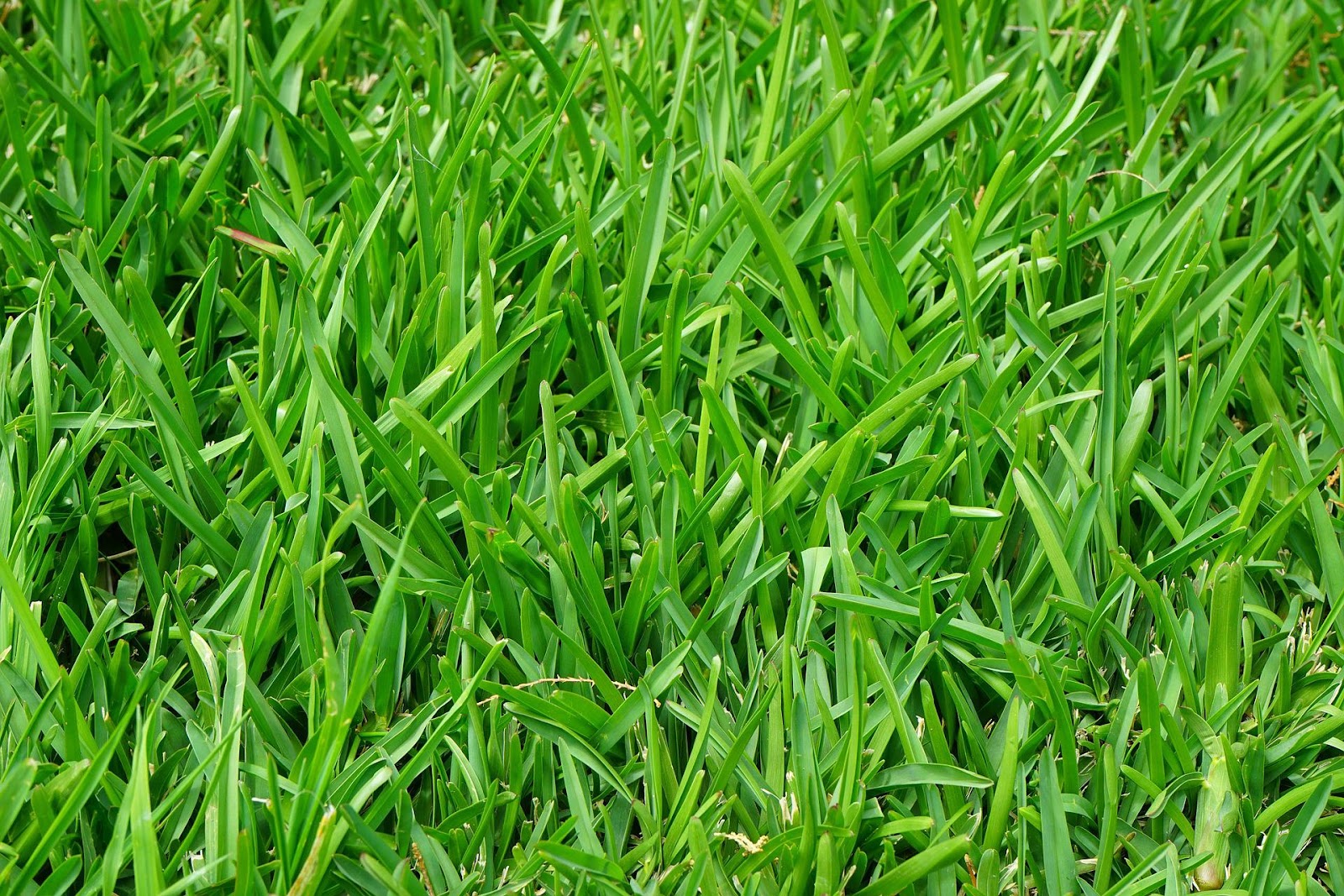
Image by Hans on Pixabay
Kentucky Bluegrass is probably the most famous grass for horses. It does well in sandy soil (although consuming too much sand can lead to colic) and is very drought tolerant. It’s delicious and nutritious for horses of all ages and stages of life but may require additional fertilizing at some points during the year to keep it thriving.
Ryegrass is a hardy, high-yielding forage that can quickly establish itself, making it great for re-seeding neglected or overgrazed pastures. There is one critical thing to keep in mind, though: ryegrass is very high in carbohydrates and can cause laminitis in overweight horses, ponies, or other “easy keepers” (horses that gain weight easily).
Mixed grass is the best bet for most horses and ponies, and many fields will contain a mix of prevalent local grasses. This has several advantages – horses can’t overgraze on high-carb grasses like ryegrass, the field benefits from a diverse root mass to help ease erosion, and different grasses reach peak maturity at different times, ensuring there’s always something yummy for your horse to eat.
Grazing Grasses at a Glance
| Grass | Where it does well | Worth knowing |
|---|---|---|
| Timothy | Cool, wet areas. Common across mid and Northern states. | Ideal for both grazing and hay making. Soft early, leafier late in the season. |
| Fescue | Drought and dry conditions, and low pH soils. | Deep rooted and very tough. Needs less fertilizer than most. |
| Bermuda grass | Warm climates. Prevalent in Southern states. | Grows fast in the right conditions. Despite the name, native to India and Africa. |
| Kentucky bluegrass | Sandy soil, and drought-prone pasture. | Suits all ages. Watch sand intake, which can cause colic, and expect to fertilize. |
| Ryegrass | Re-seeding neglected or overgrazed pasture. | Very high in carbohydrates. Can cause laminitis in overweight horses, ponies and easy keepers. |
| Mixed grass | Most fields, most horses. | The safest default. Stops overgrazing on high-carb grasses and spreads maturity across the season. |
Grasses to Avoid for Horses
Generally speaking, a horse with access to adequate grazing will not choose to eat toxic or unpalatable plants. However, if you see a field that’s well-stocked in only the following grasses, you may want to consider re-seeding or grazing elsewhere.
Orchardgrass is a tough grass that does well in dry conditions, but some horses don’t like the taste and will avoid it if they have other options.
Sorghum is toxic grass and should not be fed to horses. It contains cyanide, which can cause ataxia (a neurological lack of coordination that can render a horse unrideable for the rest of its life), incontinence, bladder inflammation, and in extreme cases, death.
Bahiagrass is a common grass in Southern states, where it thrives in the bright sunlight. However, it is extremely tough and requires a lot of chewing, which can wear down a horse’s teeth prematurely. It’s also low on nutrition and a better choice for other grazing animals like sheep or cattle, not horses.
Crabgrass is a thick, fast-growing, invasive grass that sprouts in patches. Most horses don’t love the texture, and it doesn’t offer much nutrition. It’s fine occasionally in a mixed-grass field, but avoid using it as a forage source if you can.
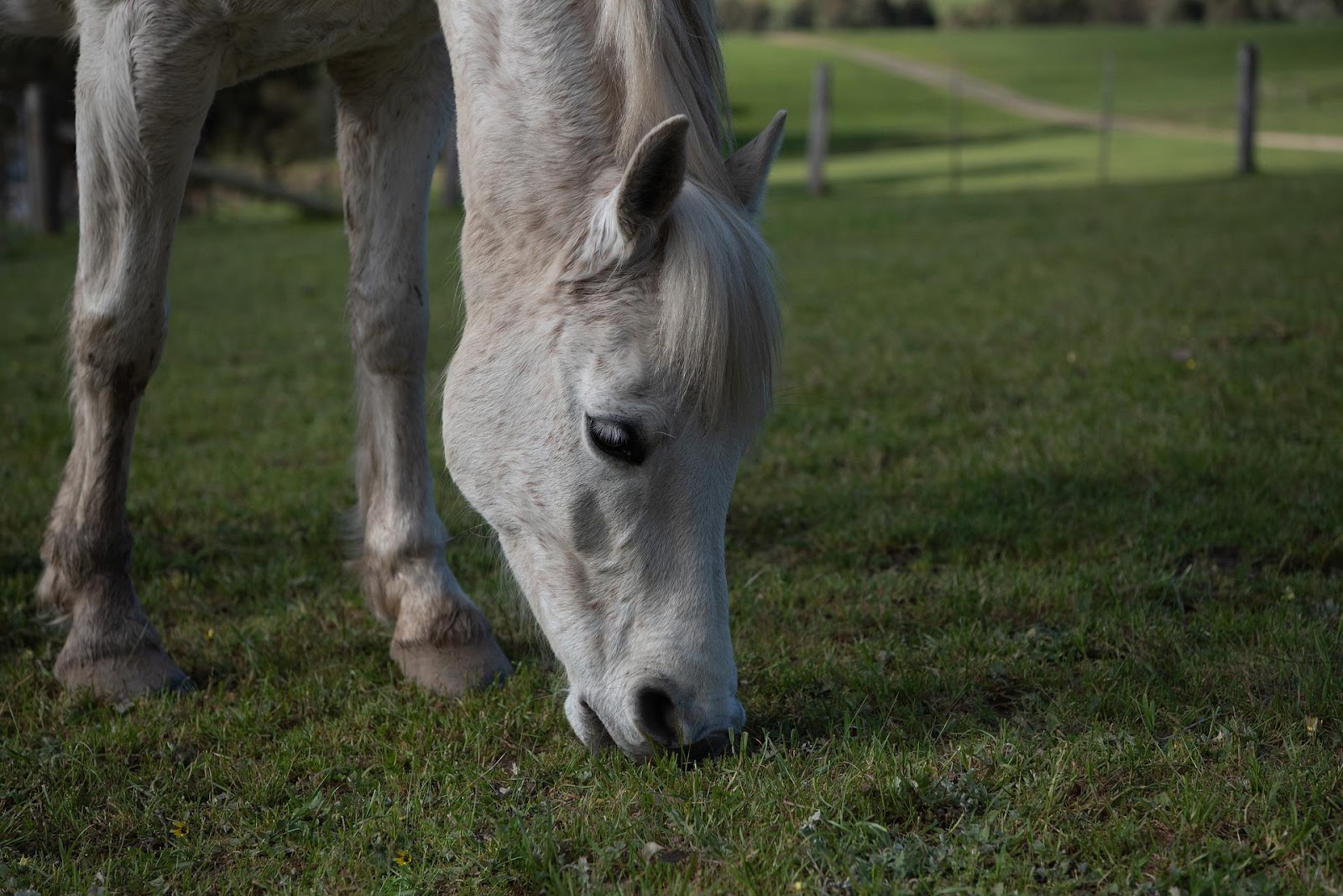
Image by pen_ash on Pixabay
How and When to Feed Grass
If horses evolved to thrive on grassy plains, shouldn’t they (ideally) be on grass 24/7? Well, not always.
As you’ve learned from the above crash course in grasses, some grasses (like ryegrass) are high in carbohydrates and can cause a bout of laminitis. But it’s not just the type of grass you need to consider, but the time of year, too.
Lush spring grass is very high in sugars and carbohydrates, which can cause obesity or laminitis in horses prone to the disease. High-risk equines include ponies, heavy horses, horses who have already foundered, and members of ‘easy keeping’ breeds like Quarter Horses, Morgans, donkeys, and native British breeds like Shetland, Dale, and Fell ponies).
Laminitis is an extremely painful foot disease involving inflammation of the laminae, which binds the hoof wall to the rest of the foot. In extreme cases, the distal phalanx (aka pedal bone or P3) can rotate through the foot’s sole, requiring euthanasia. For this reason, overgrazing an at-risk horse on lush grass needs to be avoided at all costs.
Obesity can also be a concern, typically among ‘easy keeping’ breeds. Horses with a high Body Condition Score (BCS), generally 7 or above, should not have uncontrolled access to lush spring grass.
Using a grazing muzzle can allow a horse to enjoy grazing without overeating.
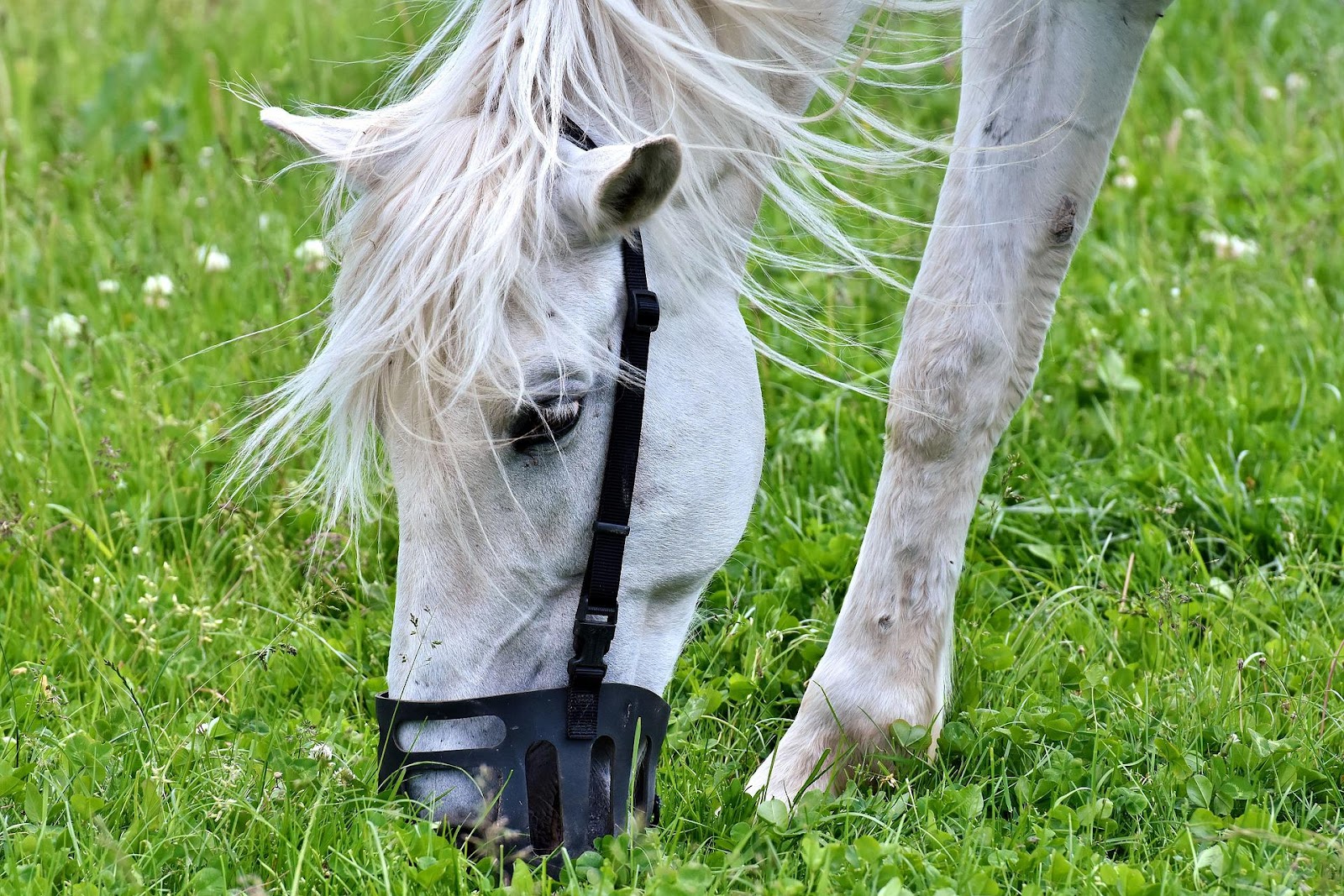
Image by Alexas_Fotos on Pixabay
Other options include limiting grazing time by increasing stall time, moving the horse to a round pen, sand ring, or overgrazed paddock with little extra grazing.
Spring grazing can also cause diarrhea. This typically happens in horses that have been fed mostly dry hay for a prolonged period (such as over winter). The sudden influx of moist, wet food can cause temporarily runny stools. To avoid grazing diarrhea, ease the horse off of hay and onto grass slowly, such as allowing a few more hours of turnout each day and continuing to supplement grazing with hay.
Hay
Hay is grass that’s been cut, dried, and baled. And just like grass, not all hays are created equal, and not all hays are appropriate for all equines.
Grass hay is generally a very safe, low-risk food appropriate for all equines. Grass hay is often comprised of a mix of Timothy, Bermudagrass, and other native grasses and has about 8-14 % protein. 10-12% protein is ideal for mature horses, and 12-18% for growing horses.
It should be light green, fresh smelling, and soft enough that it doesn’t hurt the horse’s mouth. A good rule of thumb is if it hurts your hands to hold it, it probably hurts your horse’s mouth to eat it. Grass hays have long, slender stems and few leaves, depending on the grass species.

Image by JMKLatte on Pixabay
Legume hay is much higher in protein than grass hay, coming in at 15-22% protein. This makes it an excellent choice for horses with big nutritional requirements, like growing horses or competition horses in training.
It’s a darker green than grass hay and contains more leafy greens. The leaves are higher in protein than the stems. Legume hay is most commonly alfalfa.
The high protein and carbohydrate content makes legume hay unsuitable for horses with modest nutritional needs. It’s not a good choice for horses who are already obese or prone to founder.
Mixed hay is, as the name implies, a mix of grass and legume hays. The exact mix will depend on the grower, but many hay options for horses will contain a predominantly grass hay mix, with a bit of legume hay thrown in for added protein.
Mixed hay can have a protein content anywhere from 8-18%. For an accurate analysis, either speak to the grower or take a sample to your local university extension or agricultural authority for analysis.
Hay Types Compared
| Hay type | Protein | Best for | Not ideal for |
|---|---|---|---|
| Grass hay | 8 to 14% | Almost every horse. 10 to 12% suits mature horses, 12 to 18% suits growing ones. | Few exceptions. This is the low-risk default. |
| Legume hay (usually alfalfa) | 15 to 22% | Growing horses and competition horses in training. | Horses with modest needs, already obese, or prone to founder. |
| Mixed hay | 8 to 18% | Horses needing a little more protein than grass hay alone provides. | Anyone who needs precision. Ask the grower or get it analyzed. |

Image by jmrockerman on Pixabay
How and When to Feed Hay
Most horses on grass enjoy hay during the fall and winter, when pastures dry out or are covered by snow. Hay can be fed in a net, a rack, or off the ground, and each has trade-offs. Nets slow intake down, which suits a horse who bolts his forage, while feeding off the ground is the most natural posture but means more waste and, on sandy ground, a risk of sand ingestion.
Split the daily ration across several feeds rather than one large pile. A horse’s digestive system is built for near-constant trickle feeding, and long gaps between meals are a known risk factor for ulcers. If your horse finishes his hay hours before the next feed, a net or a slow feeder will stretch it out without adding to the total.
Never feed hay that is dusty, musty, or shows white or grey mould, whatever the bale cost. Mouldy hay causes colic and respiratory problems. For horses with existing respiratory issues, soaking or steaming hay before feeding reduces the dust considerably.
Hay Cubes, Pellets, and Silage
If baled hay isn’t practical, or your horse can no longer chew it properly, processed forage is the alternative.
Hay cubes and hay pellets are chopped forage compressed into a convenient form. They store easily, carry little dust, and come with a known analysis, which makes rationing simpler. They are particularly useful for senior horses with worn teeth, since cubes and pellets can be soaked into a mash that needs almost no chewing. Soaking is worth doing as a habit either way, because dry cubes fed to a greedy horse are a choke risk.
Haylage and silage are forage cut and then fermented rather than dried, so they hold far more moisture. The lower dust makes haylage a popular choice for horses with respiratory problems. The trade-off is that it spoils quickly once opened, so a bale needs using within a few days, and any that smells sour or shows mould must be thrown away rather than risked.
Concentrates
Concentrates are what you add when roughage alone cannot meet your horse’s needs. That is usually one of two situations: he is working hard enough that he cannot eat enough forage to keep condition on, or his forage is adequate for calories but short on vitamins and minerals.
The important thing to hold onto is that concentrates supplement the diet, they do not form it. Forage first, always.
Grains such as oats, barley and corn are the traditional energy source, dense in starch and useful for hard-working horses. That same starch density is the risk: a large grain meal can overwhelm the small intestine and push undigested starch into the hindgut, where it ferments and causes problems.
Pelleted and textured feeds are commercially formulated mixes, balanced for a particular type of horse and labelled with a feeding rate. For most owners these are easier to get right than mixing grains, because the guesswork has been done.
Ration balancers are concentrated vitamins, minerals and protein in a small daily serving, with very few calories attached. They suit the horse who holds weight nicely on forage but whose hay is nutritionally thin, which describes a great many horses on hay through winter.
Sweet feed is a grain mix coated in molasses. Horses love it, and that palatability makes it handy for fussy eaters or for hiding supplements. The sugar content makes it a poor choice for any horse with a metabolic condition, a history of laminitis, or a tendency to get excitable.
How and When to Feed Concentrates
Weigh concentrates rather than scooping them. A scoop of pellets and a scoop of oats differ substantially in weight, and feeding by volume is how horses end up getting far more than intended.
Split the daily amount into two or more small meals instead of one big one. A horse’s stomach is small and a large single meal is the main driver of the starch-overload problem described above. Feed forage before concentrates, so the gut has fibre in it first.
Introduce any new feed gradually, over a week or two, mixing increasing amounts into the old one. Sudden changes are a well-known colic risk. And let a hot horse cool down properly before giving him a concentrate meal.
If you are unsure how much your horse needs, an equine nutritionist or your vet can assess his condition, workload and forage together. That is a better basis for a ration than a feed bag label alone.
Conclusion
Feeding a horse well is less about finding the perfect product and more about getting the proportions right. Roughage should do the heavy lifting, concentrates should fill the gaps that are actually there, and changes to either should happen slowly.
Pay attention to the season, know what is growing in your pasture, and keep an eye on your horse’s condition rather than the feed room. If something is not working, the answer is usually in the forage before it is in the bucket.


